Faced with climatic, economic and regulatory challenges, the world of agriculture is in the throes of a major transformation, widely documented by public institutions and research bodies. Among the emerging solutions, agrivoltaics (or agri-PV) is emerging as a major innovation, combining agricultural production and photovoltaic electricity generation on the same plot of land. Long viewed with caution, agri-PV is now recognised as a genuine lever for resilience and performance on farms.
This solution offers a number of advantages from the farmer’s point of view.
1. A stable additional income
One of the first benefits of agri-PV is economic, as many institutional and professional analyses have emphasised. By integrating renewable energy production into the farm, farmers diversify their sources of income.
- Stable additional income: renting out the land or sharing the value of the electricity produced means you can secure part of your sales over the long term.
- Reduced dependence on agricultural hazards: when faced with fluctuations in yields, commodity prices or weather conditions, agri-PV provides a less volatile source of income.
- Long-term vision: agri-PV projects generally take 20 to 30 years to complete, providing valuable financial visibility for the farmer.
2. Crop and livestock protection
Contrary to popular belief, agri-PV installations are not limited to producing electricity: they are designed to serve agricultural activity as a priority, in accordance with the framework defined by the public authorities and the regulations.
For crops
These agronomic benefits are the subject of research and field trials, particularly in Europe.
- Protection against climatic hazards: photovoltaic structures can reduce the impact of extreme heat, frost, hail or excessive rain.
- Reduced water stress: partial shading limits evapotranspiration and contributes to better water management.
- Improving certain yields: for sensitive crops (market gardening, arboriculture, viticulture), controlled shading can improve the quality and regularity of production.
For breeding
The positive impact on animal welfare and productivity has also been highlighted by a number of technical studies and feedback.
- Increased animal comfort: the panels provide areas of shade that are much appreciated by the animals, particularly during heatwaves.
- Reduced heat stress: less stressed cattle are often more productive and healthier.
3. Adapting to climate change
Climate change is already a reality for farmers, as shown by numerous scientific studies and public reports. Agri-PV is therefore a practical adaptation tool.
- Climate buffer: modulation of sunshine, protection against extreme events, better control of the microclimate.
- Intelligent light management: some systems allow the inclination or density of panels to be adjusted according to agronomic needs.
- Soil conservation: reducing erosion and maintaining better soil moisture.
In this way, agri-PV is helping to make farms more resilient in the face of increasingly unpredictable weather conditions.
4. Maintaining the agricultural vocation of the land
One of the key points of agri-PV is the maintenance of significant agricultural activity on the equipped plots, which is an essential condition for the recognition and sustainability of the projects.
- Agriculture remains the main land use.
- The projects are designed in consultation with the farmer to adapt to existing practices.
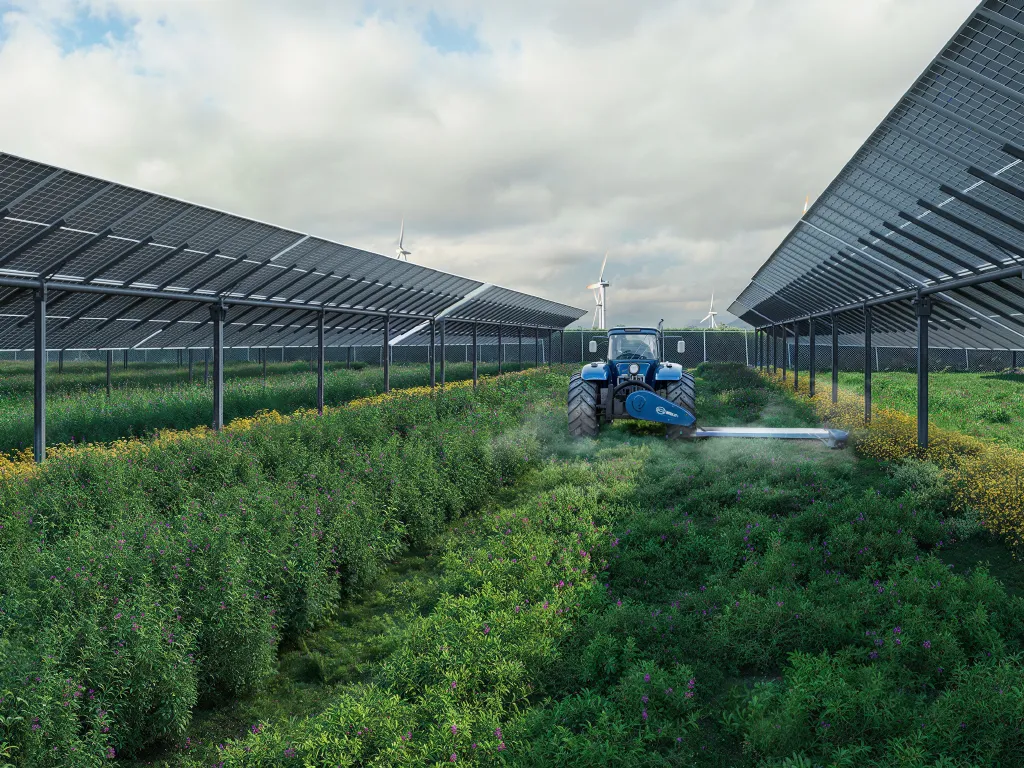
- The systems (height of structures, spacing of rows, access to machinery) are designed to guarantee continuity of agricultural work. The spacing between rows of panels allows agricultural machinery and equipment to pass through.
5. Developing and passing on the farm
A well-designed agri-PV project can also enhance the overall value of the farm, as shown by the socio-economic analyses carried out by the agricultural networks.
- Attractiveness for takeovers: a farm with a secure income and modern infrastructure is more attractive to young farmers.
- Help with transferring ownership: income from agri-PV can help finance a takeover or setting-up.
- Innovative and sustainable image: farmers are becoming players in the energy transition, an asset that is increasingly recognised by institutional and financial partners.
6. Contributing to the energy transition
By getting involved in an agri-PV project, farmers are actively participating in the production of local renewable energy, a central objective of Europe’s energy transition.
- Decarbonised electricity generation
- Contributing to regional energy independence
- Improved social acceptability of photovoltaic projects, thanks to their proven agricultural usefulness
This dual production – agricultural and energy – gives meaning to the project, beyond the purely economic aspect.
Conclusion
Agri-PV represents a major opportunity for farmers who want to secure their business, adapt to climate change and prepare for the future of their farms. When properly designed, with agriculture at the heart of the project, agri-voltaics becomes a genuine tool for agronomic, economic and environmental performance.
More than just a photovoltaic installation, agri-PV is a new way of thinking about agriculture: more resilient, more sustainable and looking to the long term.